How to Keep Houseplants Alive in a British Winter Flat
This page contains affiliate links. As an Amazon Associate we earn from qualifying purchases — this does not affect the price you pay.
You’ve probably noticed the leaves on your monstera curling inwards and the peace lily drooping like it’s had a bad night. It isn’t you being a bad plant parent. It’s the brutal winter squeeze that British flats love to hand out: radiators blasting dry heat while the north-facing windows offer barely a glint of daylight. Surviving this season means tweaking your watering, boosting humidity, and accepting that some plants just aren’t built for a dark January.
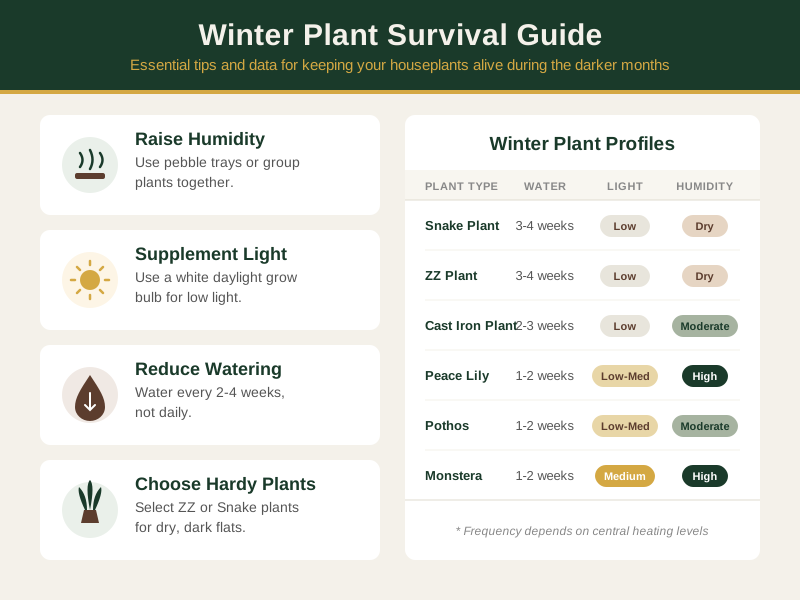
Quick reference: See the infographic below for a visual summary of the key points, or download the data table for full details.
Quick Picks
- Sansi 15W grow light (paid link) View on Amazon → (paid link)
- Growth Technology Houseplant Focus (paid link) Buy on Amazon → (paid link)
- Soil Ninja House Plant Potting Soil (paid link) Check price on Amazon → (paid link)
- SB Plant Invigorator (paid link) See current price on Amazon → (paid link)
How Do You Stop Central Heating Killing Your Houseplants?
Central heating kills houseplants by slashing relative indoor humidity to under 30%, which draws moisture out of the foliage faster than the roots can absorb it. To stop this, you need to raise the local humidity around the plant without overwatering the soil.
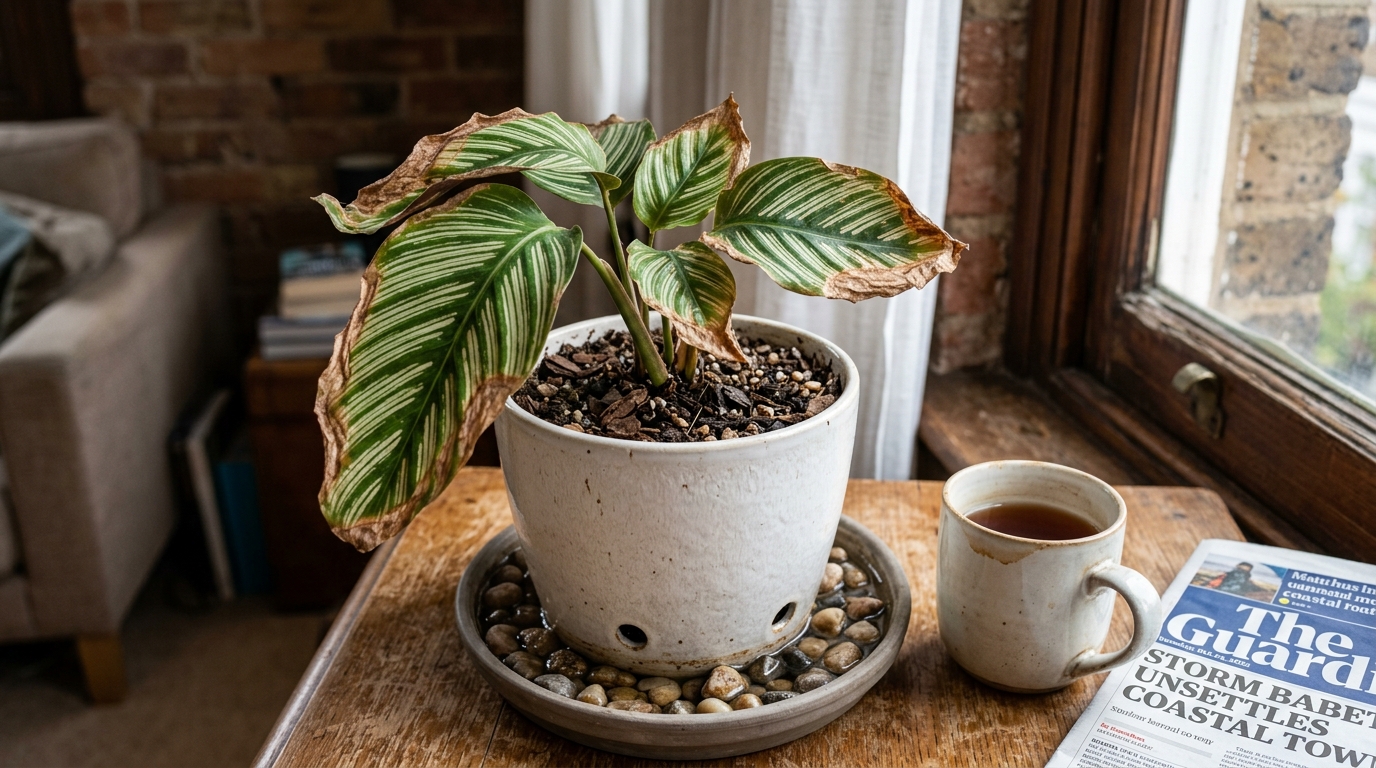
Radiators are brilliant for keeping the flat cosy, but they’re terrible at keeping the air moist. Many learn this the hard way when a calathea is perched right next to a radiator; within a week the edges look like burnt toast. According to the Royal Horticultural Society (RHS), most tropical houseplants need a humidity level of at least 50% to prevent leaf edge browning.
Misting might feel nice, but it leaves water on the foliage for far too long, inviting fungal spots. The real win is a humidity station: a shallow tray filled with pebbles and water, with the pot sitting on the stones so the base isn’t submerged. The water evaporates slowly, raising the local humidity without drowning the roots. Set one up on a kitchen sill and the difference was spot on – the once-crisp leaves softened within days.
A simple, cost-free trick is to group your plants together on a shelf or coffee table. Their collective transpiration creates a micro-climate that can add a few percentage points of humidity – a simple belt-and-braces approach that costs nothing.
We’ve documented more of our ongoing humidity experiments over on the blog if you want to see what else has worked.
The “Low Light” Reality: Light Intensity vs. Plant Needs
A north-facing window in December barely supplies enough light to read a paperback without squinting. That’s not “no light” – it’s low light, which means plants grow slower and stretch, producing that leggy look you’ve probably seen on your pothos.
Light Check: Can you comfortably read a book on the sill in the middle of the day? If not, you’re in the low-light zone. You don’t need a full-blown grow-room, just a little extra boost. Rotate your plants weekly so each side gets a turn toward the window; this evens out growth and prevents one side from turning into a lanky twig.
When the flat is genuinely dark, the Sansi 15W grow light (paid link) (a 2-pack of E27 daylight bulbs, roughly £15-20) proves its worth. We’ve used it screwed into a regular lamp socket and seen seedlings sprout faster than on the windowsill alone. It’s a white bulb that mimics daylight without the harsh purple glow of cheap LEDs. For those watching the budget, the Garpsen clip-on grow light (paid link) clips onto a shelf or pot, and while its coverage is limited, it’s honest value for a starter kit.
Check Garpsen clip-on grow light price → (paid link)
Remember, low light isn’t a death sentence; it just means you pick shade-tolerant varieties. A ficus, for instance, will struggle, while a ZZ plant will thrive.
How Often Should You Water Houseplants in Winter?
You should water most houseplants every two to four weeks in winter, which is roughly half as often as you would in the summer. Winter slows plant metabolism, meaning they sip far less water, and overwatering in a cold, low-light flat is the fastest route to root rot.
Rule of thumb: Stick your finger into the top inch of soil; if it feels dry, it’s time to water. Otherwise, wait. Watering a monstera every five days because the soil looks damp can mean the roots are quietly rotting – the plant turned yellow and started shedding leaves.
Hard water is another silent killer. The Drinking Water Inspectorate notes that much of the UK has hard or very hard tap water, and those minerals can build up on leaves and in the soil, especially for sensitive plants like calatheas and ferns. For those, filtered water from a simple jug is a cheap fix that makes a world of difference.
When you do water, aim for a clear schedule:
- Check soil moisture every 7–10 days (more often for fast-drying mixes).
- Water thoroughly in the sink, letting excess drain away completely.
- Avoid letting pots sit in saucers of water – that’s a recipe for root rot.
For a nutrient boost without encouraging rapid, leggy growth, Growth Technology Houseplant Focus (paid link) works wonders on foliage plants; it keeps leaves glossy and roots robust. If you’re after a budget option, the Miracle-Gro Organic Pump & Feed Houseplant (paid link) (200 ml) is easy to dose, though you’ll need to be careful not to over-dose.
Check Miracle-Gro Organic Pump & Feed Houseplant price → (paid link)
The “Tough List”: Plants That Survive the British Winter
If you’re starting from scratch or need a rescue plan, these hardy choices are practically built for north-facing flats and dry heat.
- Snake Plant (Sansevieria): Survival rating 5/5. Loves low light, tolerates dry air, and only needs watering every 3–4 weeks.
- ZZ Plant (Zamioculcas zamiifolia): Survival rating 5/5. Thrives in low light, stores water in rhizomes, and can go months without a drink.
- Cast Iron Plant (Aspidistra elatior): Survival rating 5/5. The Victorian classic that loves shade and tolerates cooler temperatures.
- Peace Lily (Spathiphyllum): Survival rating 4/5. It’ll droop dramatically when thirsty – a useful indicator – but bounces back with a good watering routine.
- Pothos (Epipremnum aureum): Survival rating 4/5. Tolerates low light and irregular watering; perfect for a hanging basket near a radiator.
For aroids like monstera, the Soil Ninja House Plant Potting Soil (paid link) is a peat-free coir and perlite mix that drains well, but the Westland Houseplant Potting Mix (paid link) (4 L, peat-free) is the best value choice that works fine for most foliage plants.
See Westland Houseplant Potting Mix on Amazon → (paid link)
The “Recovery Plan”: What to Do If Plants Are Already Struggling
Brown tips? Snip them cleanly with sharp scissors – it’s mostly cosmetic, but it does improve the plant’s appearance. Check the humidity station; if the air is still bone-dry, add another tray or a small tabletop humidifier.
Leggy growth? Trim back the elongated stems by about a third. This encourages bushier side shoots once the light improves in spring. Don’t bin the plant – it’s often just crying out for more light.
Yellow leaves? First, feel the soil. If it’s soggy, hold off watering completely and let it dry out. If it’s bone-dry, give a deep drink and consider feeding with Growth Technology Houseplant Focus (paid link). For a cheaper feed, the Miracle-Gro Organic Pump & Feed (paid link) does the job, just watch the dosage.
Pests on the underside? A quick spray of SB Plant Invigorator (paid link) works as both a foliar feed and a mild pesticide, keeping spider mites and mealybugs at bay. If you’re on a shoestring, Doff Universal Bug Control (paid link) is the best value Amazon spray – it knocks down early-stage aphids but can be a bit harsh on delicate foliage, so test on a single leaf first.
Buy Doff Universal Bug Control on Amazon → (paid link)
Recovery Checklist:
- Prune brown tips and leggy stems.
- Test soil moisture; adjust watering schedule.
- Inspect undersides of leaves for pests; treat if needed.
- Boost humidity with a pebble tray or humidifier.
Winter Plant Care Schedule
| Plant Type | Watering Frequency | Light Requirement | Humidity Preference |
|---|---|---|---|
| Snake Plant | Every 3-4 weeks | Low light tolerant | Dry air tolerant |
| ZZ Plant | Every 3-4 weeks | Low light tolerant | Dry air tolerant |
| Cast Iron Plant | Every 2-3 weeks | Low light tolerant | Moderate humidity |
| Peace Lily | Every 1-2 weeks | Low to medium light | High humidity needed |
| Pothos | Every 1-2 weeks | Low to medium light | Moderate humidity |
| Monstera | Every 1-2 weeks | Medium light | High humidity needed |
What to Do Next
You now have the four pillars of a British winter plant survival kit: raise humidity without turning your flat into a swamp, supplement low light with a modest grow bulb, cut your watering frequency in half, and choose plants that thrive on neglect. Remember, the winter environment is harsh but not unbeatable – a few tweaks and the right plant selection can keep your collection thriving until the sun finally returns.
If you’re still not sure whether your plant is over- or underwatered, you can always reach out via the contact page and we can point you toward the free troubleshooting checklist.
Keep an eye on your leaves, stay patient, and don’t be afraid to experiment – after all, the best lessons come from a bit of a faff and a lot of love. If you want to know more about how we got started with plants, have a read of our about page. Happy winter gardening!
Explore More Topics
Go deeper on specific topics:
- Does UK Hard Water Affect Houseplants? (And How to Fix It)
- Can You Repot Plants in Winter? UK Cold Weather Guide
- How to Increase Humidity for Houseplants in a Dry UK Home
References
Products linked above are ones we recommend based on owner feedback and UK-condition testing.
Note: This guide provides general recommendations for indoor plant care in the UK. Always verify specific needs for your plant varieties and consult a qualified professional or official source for critical care decisions.
Related Guides
This article is part of our UK Indoor Plant Care: Surviving Central Heating & Low Light series. You may also find these guides useful: