Why Are My Plant Leaves Turning Yellow? (UK Troubleshooting Guide)
This page contains affiliate links. As an Amazon Associate we earn from qualifying purchases — this does not affect the price you pay.
Following on from our Houseplant Troubleshooting: How to Save a Dying Plant overview, this guide digs into one specific symptom and what to do about it.
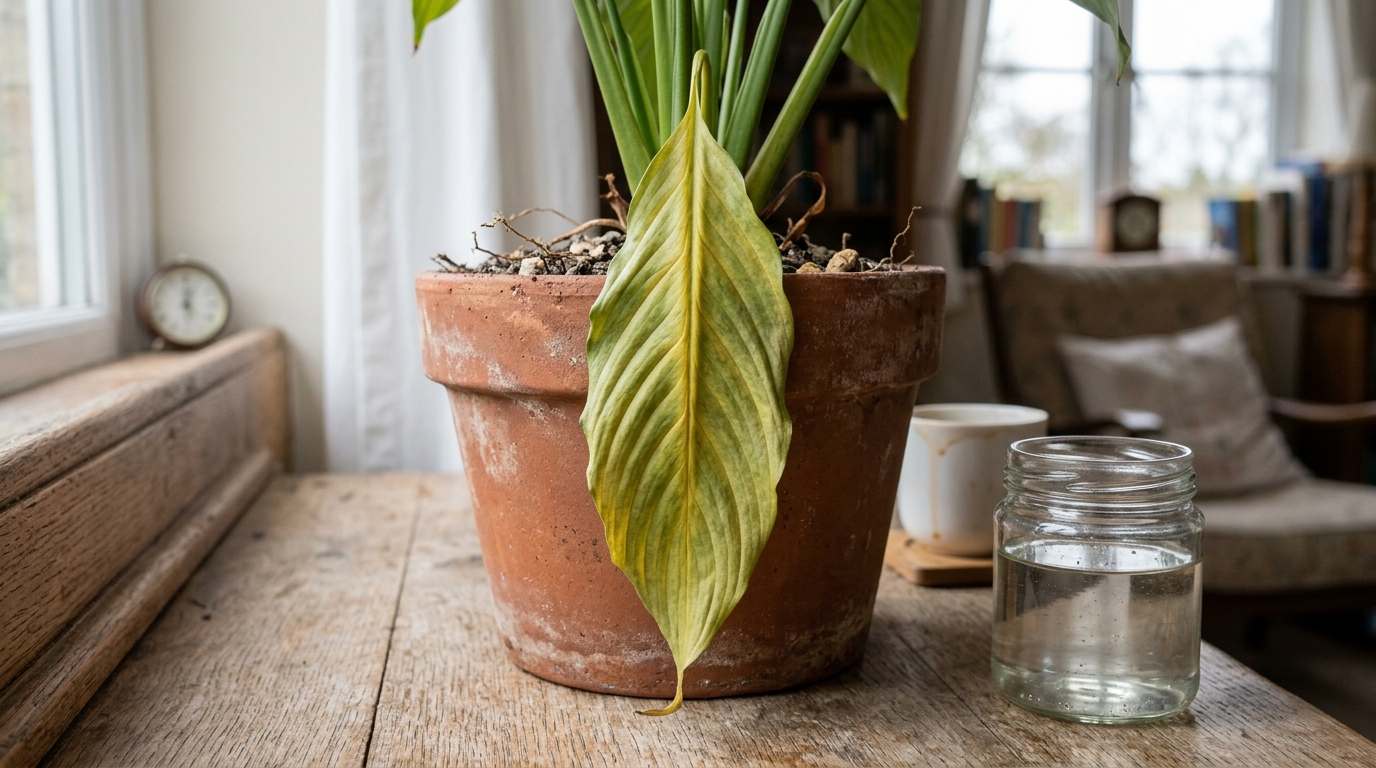
Your peace lily’s once-vibrant foliage is now a buttery yellow, and that familiar panic is setting in. Most plant parents have been there—the moment yellow tips appear on a calathea, many think they have killed it for good, only to discover the radiators were the silent culprits. Yellow leaves are rarely a death sentence; they’re just a clear SOS from your plant.
The “Yellow Leaf” Diagnostic Flow
Houseplant leaves turn yellow for several reasons, but the most common culprits in British homes are overwatering, dry air from central heating, and limescale build-up from hard tap water. To fix a yellowing plant, you first need to identify the pattern.
Where the yellow shows up tells you almost everything you need to know:
- Bottom leaves turning yellow – usually the plant shedding old foliage or a sign of underwatering.
- Yellowing tips (brown-ish edges) – often a humidity issue, underwatering, or salt build-up from hard water.
- Whole plant yellowing suddenly – classic overwatering or early root rot.
- Spotty yellow patches – pests or disease are likely at work.
Here is how to use this checklist to diagnose your plant quickly:
- Look at the oldest leaves at the base. Are they yellow and dry, or just yellow and limp?
- Inspect the leaf margins. Are the tips crisp or soft?
- Feel the soil – does it stay soggy for days, or does it dry out quickly?
- Check the underside of the leaves for tiny insects or fine webbing.
If you’re seeing yellow at the bottom, don’t panic—it’s often natural leaf turnover. But if the tips are crispy, you’re probably dealing with low humidity or hard water. A sudden, uniform yellowing across the whole plant? Grab a moisture meter (or just use your finger) and prepare to flush the soil. Spotty yellow? Pull out a magnifying glass and look for pests.
The location of the yellowing is the key to the cure. Once you’ve pinpointed the symptom, the remedy becomes a lot more straightforward.
Is Hard UK Tap Water Causing My Yellow Leaves?
Yes, if you live in a hard water area, the limescale in your tap water can coat plant roots and cause a slow, creeping yellowing. Most UK tap water sits somewhere between 150–300 mg/L of calcium carbonate—that’s hard enough to leave a visible limescale ring on your kettle. For plants that love soft water, that mineral cocktail builds up in the potting soil, causing a slow decline that’s incredibly easy to misread as a nutrient issue.
According to RHS guidance on watering houseplants, many popular indoor plants are “lime-hating” and particularly sensitive to the alkaline salts that accumulate when hard water evaporates from the soil surface. Over time, you’ll see yellowing older leaves, brown tips, and a general loss of vigour.
Here is what you can do to fix a hard water problem:
- Collect rainwater in a clean bucket or water butt; it’s naturally soft and exactly what your plants want.
- Use filtered water – a simple Brita jug works perfectly well for most flats.
- Let tap water sit uncovered for 24 hours; this allows the chlorine to evaporate, though it won’t actually remove the hardness.
- Test your water with a cheap hardness test strip (around £5-£8 online). If the reading is above 180 mg/L, you’re in the hard-water zone.
Plants that struggle the most with hard water include:
- Peace lily (Spathiphyllum)
- Calathea (especially ‘Rattlesnake’)
- Boston fern (Nephrolepis)
- African violet (Saintpaulia)
A peace lily that yellows slowly for no obvious reason is a classic case: try collected rainwater before you reach for plant feed.
The “Central Heating” Factor
Winter in a British flat means radiators humming, dry air, and plants wilting in the glow. The dry air from central heating can pull moisture right out of leaf cells, leading to yellowing tips and an overall crispy pallor.
When the heating goes on, two main things happen to your indoor environment:
- Humidity drops to 20-30% near a radiator, which is far below the 40-60% most tropical houseplants actually need to survive.
- Temperature swings occur – a warm radiator next to a cold, draughty window creates shock zones that severely stress foliage.
You can combat this with a few simple fixes:
- Create a humidity tray: place a shallow saucer with pebbles and add water until it just covers the base of the stones. Set your pot on top; as the water evaporates, it raises the local humidity directly around the leaves.
- Misting: a quick mist once a day (especially for calatheas) helps slightly, but don’t over-do it, as constantly wet leaves can invite fungal issues.
- Move the plant at least a metre away from direct radiator heat or use a small fan to circulate the air in the room.
Placing a monstera right beside a ceiling vent turns the lower leaves yellow within a week. A cheap humidity tray (roughly £10-£15) and a bit of repositioning sorted it out entirely, and the plant perked up nicely.
Nutrient Deficiencies & Fertiliser Fixes
Yellowing can be a sign of chlorosis—meaning the plant isn’t getting enough nitrogen, iron, or magnesium. Conversely, over-feeding can scorch the roots and cause exactly the same symptom.
Here is what to look out for when diagnosing feeding issues:
- Older leaves yellowing uniformly – likely a nitrogen deficiency.
- New growth turning yellow – could be an iron or magnesium shortage, which is often linked to the high pH found in some peat-free composts.
- Yellow edges with brown tips – classic over-fertiliser burn.
To feed your plants correctly without causing damage:
- Choose a balanced liquid feed such as Growth Technology Houseplant Focus (paid link).
- Dilute to ¼ strength (about 5 ml per litre of water) – a very common mistake is using full strength and burning the roots.
- Feed every 4-6 weeks during the main growing season from April to September.
- Skip feeding in winter unless you see clear signs of a deficiency, as the plant’s growth naturally slows down when light levels drop.
Check Growth Technology Houseplant Focus price → (paid link)
If you suspect a pH issue, adding a teaspoon of garden lime to the topsoil every spring can raise the pH slightly and make iron more available to the roots.
Over-dosing a peace lily with a generic 10-10-10 fertiliser at full strength turns the leaves yellow overnight. Cutting the dose back to a quarter and switching to a foliage-focused feed brought the plant back to life within a month.
Pest Control (Fungus Gnats & Spider Mites)
Tiny pests can easily masquerade as yellowing foliage by attacking the roots out of sight or sucking sap directly from the leaves.
- Fungus gnats: According to RHS advice on fungus gnats, their larvae feed on fine root hairs in the soil, drastically reducing water uptake and causing yellow, wilting leaves.
- Spider mites: These tiny arachnids puncture leaf cells, leaving stippled yellow patches that can quickly spread across the whole plant if left unchecked.
Here are a few effective, low-budget solutions:
- Sticky traps (Blooven fungus gnat sticky traps (paid link)) – place a few around the base of the pot to catch the adult gnats. A large yellow pack gives you an instant visual read-out of how bad the infestation actually is.
- Soil drench with neem oil or SB Plant Invigorator (paid link) spray – this works on both gnat larvae and spider mites without relying on harsh chemicals. We’ve found the Invigorator spray to be worth the investment for regular preventative use; just watch out for an occasional sticky residue if you spray too heavily.
- Dry the top 2 cm of soil completely between waterings, as gnats absolutely love constantly damp compost.
See Blooven fungus gnat sticky traps on Amazon → (paid link)
See SB Plant Invigorator on Amazon → (paid link)
If you find yourself constantly battling bugs, you can read more of our pest control routines on the blog.
How to Save a Yellowing Plant (Recovery Plan)
1. Check the soil moisture Stick your finger about 2 cm deep into the compost. If it feels soggy and smells a bit like a pond, you’re overwatering and need to let it dry out immediately. If it’s bone-dry and pulling away from the sides of the pot, it needs a thorough drink.
2. Flush the soil Gently run lukewarm water through the pot until it drains clear out of the bottom holes. This helps leach out excess fertiliser salts and the limescale build-up from hard tap water that blocks nutrient uptake.
3. Adjust the lighting Move the plant to a bright, indirect spot out of the harsh midday sun. If you’re in a dark flat with only a north-facing windowsill, a modest LED grow light (you’re looking at roughly £20-£30) can stop shade-induced yellowing in its tracks.
4. Boost the humidity Set up a pebble tray underneath the pot or run a small humidifier for an hour each evening during winter. Getting the plant away from the direct, dry blast of a hot radiator is half the battle won.
5. Trim the yellow leaves Use clean scissors to cut the dying foliage back to the first green node or the base of the stem. Yellow leaves won’t turn green again, and removing them redirects the plant’s energy into pushing out healthy new growth.
6. Feed lightly Once the plant has stabilised, apply a quarter-strength balanced houseplant feed once a month. Don’t feed a highly stressed or bone-dry plant, as this can scorch the roots and make the yellowing significantly worse.
Patience is key here; you’ll often see new green shoots appear a fortnight after you’ve corrected the environment. If root rot is heavily suspected, repot immediately into fresh, well-draining peat-free compost and cut your losses on the mushy roots.
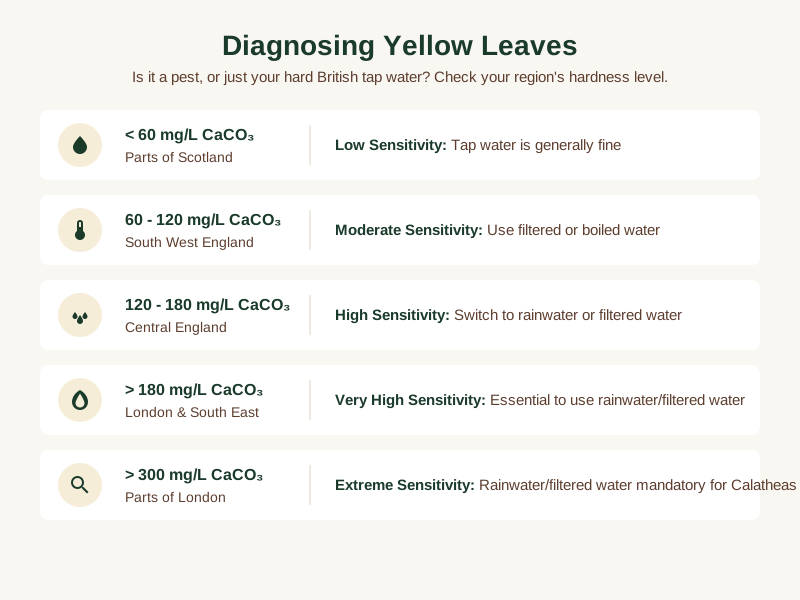
UK Hard Water Zones & Plant Sensitivity
| Hardness Level (mg/L CaCO3) | UK Region Example | Plant Sensitivity | Recommended Water Source |
|---|---|---|---|
| < 60 | Parts of Scotland | Low | Tap water is generally fine |
| 60 - 120 | South West England | Moderate | Use filtered or boiled water |
| 120 - 180 | Central England | High | Switch to rainwater or filtered water |
| > 180 | London & South East | Very High | Essential to use rainwater or distilled water |
| > 300 | Parts of London | Extreme | Rainwater or filtered water is mandatory for sensitive plants like Calatheas |
Before You Buy
If you are dealing with related issues, see our guide to How to Save an Overwatered Plant from Root Rot. Yellow leaves are a clear sign that something in your plant’s environment is out of balance, but they’re also a highly manageable problem. By pinpointing where the yellow shows up, swapping hard tap water for a softer alternative, taming the dry air from central heating, feeding wisely, and keeping pests at bay, you’ll give your foliage a solid chance to bounce back.
If you’d like a quick reference to run through this process every time a plant looks off, grab our free Houseplant Troubleshooting Checklist – it’s a handy one-page guide that walks you through the exact same diagnostic flow we’ve just covered.
Got more questions or need a hand with a particularly stubborn plant? Feel free to get in touch. A little patience and the right water can turn those yellow warnings back into vibrant green — usually within two weeks of fixing the root cause.
Related Guides
For a complete overview, see our Houseplant Troubleshooting: How to Save a Dying Plant.
References
Products linked above are ones we recommend based on owner feedback and UK-condition testing.
Note: This guide provides general troubleshooting advice for houseplants. Always verify specific plant requirements and consult a qualified professional or official source for detailed diagnosis and treatment.