Why Is My Mint Plant So Leggy?
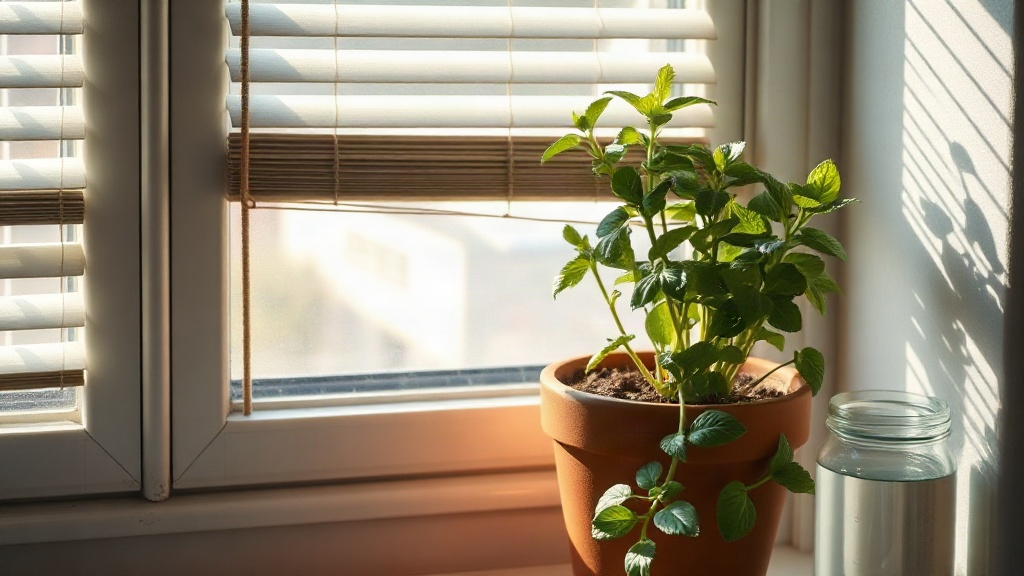
This page contains affiliate links. As an Amazon Associate we earn from qualifying purchases — this does not affect the price you pay.
A leggy mint plant is the most fixable windowsill problem because mint regrows from every node. A hard cut plus corrected light restores compact growth within weeks. This article gives both halves of that fix.
You bought a mint plant expecting a neat little pot of bushy green leaves for your tea. Three weeks later, you have something that looks more like a spiderweb crawling across the glass—long, stringy stems reaching towards the window, with sparse leaves spaced out like they’re embarrassed to be there.
Sound familiar? The problem isn’t the plant. It’s not bad soil or bad luck. It’s the light—or more specifically, the mismatch between what mint needs to thrive and what your windowsill is actually providing.
Mint can grow in full sun or partial shade. In its natural habitat, it basks in direct light for hours every day. Put it on a windowsill receiving little direct sun, and it does exactly what any sensible organism does when it’s starving: it stretches toward whatever light it can find. That’s what “leggy” actually is. Your mint is telling you it can’t photosynthesise properly, so it’s gambling everything on reaching just a bit more sun.
The good news is this is fixable. In many cases, you can turn that one sad, stretched-out plant into several compact ones. You need to understand what’s happening first—watering differently or feeding more won’t touch the real problem.
Understanding the root cause of leggy growth
Leggy growth is the common name for a botanical condition called etiolation. It’s not a disease or a deficiency—it’s a survival response. When a plant can’t get enough light to fuel normal growth, it diverts resources toward one goal: reaching more light, fast.
The mechanism is straightforward. In low light, a plant’s cells elongate—the stem stretches longer than it should, and leaves stay smaller and further apart. This isn’t random; it’s an evolved strategy. The plant is gambling that somewhere above, there’s more sun.
Visually, etiolated mint is distinctive. You’ll see long, thin stems that look weak and pale compared to healthy growth. The leaves are smaller and spaced further apart, often with bare sections between leaf nodes that would normally be packed tight. The plant often leans toward the window, sometimes dramatically so.
This is one of the most common complaints from people growing mint on a windowsill—mint that ends up looking like a spiderweb after a month in a flat with limited light. The plant isn’t dying; it’s just prioritising survival over compact growth. It would happily stay small and bushy if you gave it enough light.
If you want to understand the full picture of what mint needs to thrive, our mint care guide covers watering, soil, and ongoing maintenance in more detail.
Three mistaken causes to rule out
Before you start overhauling your mint’s entire existence, rule out the other usual suspects. Three things commonly get blamed for leggy growth when they aren’t actually the cause.
Overwatering is a common misunderstanding. If your mint’s stems are mushy, yellowing from the bottom up, or smelling vaguely of rot, that’s overwatering causing root rot—not leggy growth. These are different problems. Leggy mint has firm stems and looks stretched, not collapsed. Overwatered mint looks sick and might be wilting despite wet soil. The fix for root rot is letting the soil dry out and improving drainage. The fix for leggy growth is more light.
Pests can weaken plants and sometimes cause distorted growth, but spider mites and aphids don’t cause the specific pattern of long, thin, stretched stems reaching toward light. If your mint has webbing under the leaves, tiny moving dots, or distorted new growth, that’s a pest problem worth treating separately. It won’t explain why the plant is stretching.
Lack of pruning contributes to length over time, but it doesn’t cause the initial stretching. If you never prune mint, it will eventually get long and woody—that’s just how it grows. But the desperate, pale, reaching-for-light quality that makes mint look like it’s falling apart? That’s etiolation, and it happens even on perfectly well-pruned plants if the light isn’t there.
If your mint is stretching and pale with weak, widely-spaced leaves, light is almost certainly the driver. Check your watering routine and inspect for pests while you’re at it, but don’t expect either to solve the stretching problem.
What mint really needs to grow compact
Here’s the part that matters most, and where most generic advice falls short.
Mint grows well in full sun or partial shade. Most sources will tell you it “tolerates partial shade”—technically true. What they don’t explain is what “tolerates” means in practice. In low light, mint doesn’t die. It doesn’t even look obviously sick at first. It just slowly stretches into that leggy, weak, reaching form you’re probably looking at right now.
Mint generally benefits from several hours of direct sun each day. That’s broadly accurate, though your specific plant’s needs will vary depending on the variety, time of year, and heat. A south-facing windowsill in summer can provide this easily. A north-facing windowsill—even in summer—rarely comes close.
North-facing windowsills usually receive less direct sun. Direct sunlight either doesn’t reach them at all, or only does so briefly during summer months when the sun is high. In winter, when the sun stays low and the days are short, a north-facing window may receive very little direct sun. This is basic geography—the sun tracks through the southern part of the sky, so north-facing surfaces are perpetually in shadow.
Central heating makes this worse. Heated indoor air is dry, and dry soil dries out faster. This means mint in a heated flat needs watering more often than the same plant would in a cooler room. Combine short, dark winter days with dry soil from the central heating, and you’ve created the perfect conditions for a miserable, leggy mint plant.
Intensity of light matters as much as duration. Your mint might technically be getting “light” all day from a north-facing window, but it’s diffuse, ambient light—not the direct sun it craves. Your mint might as well be growing under a tree canopy.
This is why moving the pot six inches to the left—from a north-facing to a south-facing window—can transform mint from a stringy mess into something bushy and productive. The difference between indirect and direct light is the difference between your plant surviving and thriving.
Right, so you’ve confirmed the problem. Here’s what to do about it.
Practical fixes for leggy mint
You’ve got three realistic options, and the right one depends on what you have available.
Move it to a sunnier spot
If you have a south-facing windowsill, a conservatory, or a bright spot near a south-facing window, move the plant there. Give it several hours of direct sun—ideally more in summer—and new growth will come in compact and healthy. The existing leggy stems won’t shrink back, but everything the plant produces from this point will be different.
Don’t have south-facing light? A west-facing window is the next best thing—it’ll catch the afternoon and evening sun and is usually enough for decent mint growth, particularly in summer. East-facing works in a pinch. North-facing, and you’re back to square one.
Use a grow light if natural sun isn’t available
Many UK flat owners write mint off entirely here, but it doesn’t have to be complicated. A Garpsen clip-on grow light (paid link) (52 LEDs, full spectrum) plugged into a timer and clipped above your mint for several hours a day will do the job. You don’t need a specialist horticultural setup.
Check Garpsen clip-on grow light price → (paid link)
The advantage of a grow light is consistency. Winter days are short, and even south-facing windowsills get significantly less light in December than in June. A grow light removes that seasonal variation and keeps your mint growing compactly year-round.
If you want the houseplant-side comparison (bulb in a lamp vs clip-on), see how we keep houseplants alive in a British winter flat.
Prune and propagate as a rescue option
If your mint has already stretched to the point where it’s barely holding itself up, you can rescue it—and end up with more plants in the process.
The approach is simple: cut the plant back hard, taking the top two-thirds of the stems. This sounds drastic, but mint is remarkably resilient. New growth will come from the base and from leaf nodes lower down the stems. It won’t look pretty immediately, but within a few weeks, you’ll have fresh, compact shoots.
The cuttings you take aren’t waste. Mint propagates easily from stem cuttings. Take a cutting below a leaf node, strip the lower leaves, and pop it in a glass of water on a sunny windowsill. Roots may form in a few weeks. Once roots are established, pot them up and you’ve got a new mint plant—one that can go straight into better light conditions from the start.
Prune a leggy mint back hard, propagate the cuttings, and you can easily end up with several new plants from one stringy original. Mint is generous like that.
Now you know what’s causing the problem and how to fix it—grab the free troubleshooting checklist to check whether any of your other plants might be struggling with similar issues.
Maintaining compact growth
Once you’ve solved the immediate light problem, keeping mint compact is mostly a matter of ongoing maintenance. Two things make the biggest difference.
Regular pruning is non-negotiable if you want bushy mint. Every time you see new growth, pinch or cut the tips—the top set of leaves and the growing point. This stops the plant from putting all its energy into vertical growth and forces it to branch out instead. The more you pinch, the bushier it gets. Think of it like a haircut: the more regularly you trim, the better it looks.
A practical rhythm: whenever you make a cup of tea and want fresh mint, take a few stems from the top. This keeps the plant productive and compact simultaneously. You end up with mint for your tea and a better-looking plant—it’s a system that rewards you for using it.
Pot size matters more than people expect. Mint can do well in a reasonably sized container. If you pot it into a large container with lots of rich soil, it may spread its roots aggressively and put less energy into growing compact, aromatic leaves. A moderately sized pot—one where the roots are filling the space but not completely cramped—keeps mint focused on top growth.
Don’t go too small, though. Pot-bound mint will eventually stop growing entirely and may start yellowing. If you see roots coming out of the drainage holes or coiling on the soil surface, it’s time to move up one pot size. Drainage matters more than the brand — the LE TAUCI ceramic set (paid link) (11 + 13 + 17 cm) is the step up from a supermarket pot without going to a 30 cm tub.
View LE TAUCI ceramic set on Amazon → (paid link)
Common questions about leggy mint
Can I save a leggy mint plant?
Yes. Moving it to a brighter spot will stop the new growth from being leggy, and hard pruning will encourage fresh, compact shoots from the base. If the plant is severely stretched, propagate cuttings from the healthy top growth and start fresh with those—you’ll often end up with a better plant than the original.
Does mint need direct sunlight?
Mint does well with several hours of direct sun. It will survive in partial shade, but it will be leggy and weak. If you’re growing mint indoors and it’s stretching, it’s almost certainly not getting enough light, regardless of how bright the room feels to you.
Why is my mint growing so tall?
It’s stretching toward the light—a response called etiolation. In low light conditions, mint cells elongate in search of more sun, creating the long, weak stems and widely-spaced leaves characteristic of leggy growth. The fix isn’t more water or more feed; it’s more light.
How often should I prune mint?
Little and often is the best approach. Every time you harvest, take the tips rather than individual leaves—this encourages branching and keeps the plant compact. If you’re not using it regularly, check weekly and pinch back any long stems you spot. The more you prune, the better it grows.
Will mint grow back after hard pruning?
Yes. Mint is vigorous and will regenerate from the base and from lower leaf nodes after hard pruning. Give it good light, don’t overwater while it’s recovering, and you’ll see fresh growth in the growing season.
Mint light requirements
| Light Direction | Sunlight Hours | Growth Result |
|---|---|---|
| South-facing | Several hours | Compact, healthy growth |
| West-facing | Afternoon/evening | Decent growth, especially in summer |
| East-facing | Morning sun | Works in a pinch |
| North-facing | Low direct sun | Can lead to leggy growth |
Bringing it all together
For mint, picking and pruning are the same cut—harvesting little and often keeps growth compact and stops it getting leggy in the first place. A hard prune is just a reset back to that habit.
The core issue with leggy mint is almost always light—specifically, the mismatch between what mint needs to grow compact and what your windowsill is providing. Windowsills receiving little direct sun rarely deliver what mint craves, especially in winter. Once you understand that, the solution becomes obvious: more light, or a grow light to substitute it.
If your mint is already stretched, don’t despair. Hard pruning followed by propagation turns what looks like a failure into multiple fresh plants—all of which can go straight into better conditions and grow compact from day one.
Mint is one of the easier herbs to rescue. It’s resilient, grows fast, and propagates so easily that even a struggling plant can become several thriving ones with minimal effort.
If you’re wondering whether other plants in your home might be suffering from similar mismatches—light, watering, humidity—now’s the perfect time for a quick audit. Download the free houseplant troubleshooting checklist to work through each plant systematically and spot problems before they become serious. It’s a ten-minute job that could save you replacing half your windowsill collection come spring.
Related Guides
For a complete overview, see our Indoor Herb Rescue UK: Diagnose and Save Dying Windowsill Herbs.
Sources & Further Reading
General guidance only, verify details with a qualified professional or official source.