Monstera Leaves Turning Yellow: How to Diagnose and Fix
This page contains affiliate links. As an Amazon Associate we earn from qualifying purchases — this does not affect the price you pay.
Some plants show up in every British flat for a reason. Our Popular Houseplant Care: Troubleshooting the UK’s Favorite Plants hub covers the UK’s favourites; this guide tackles one specific issue.
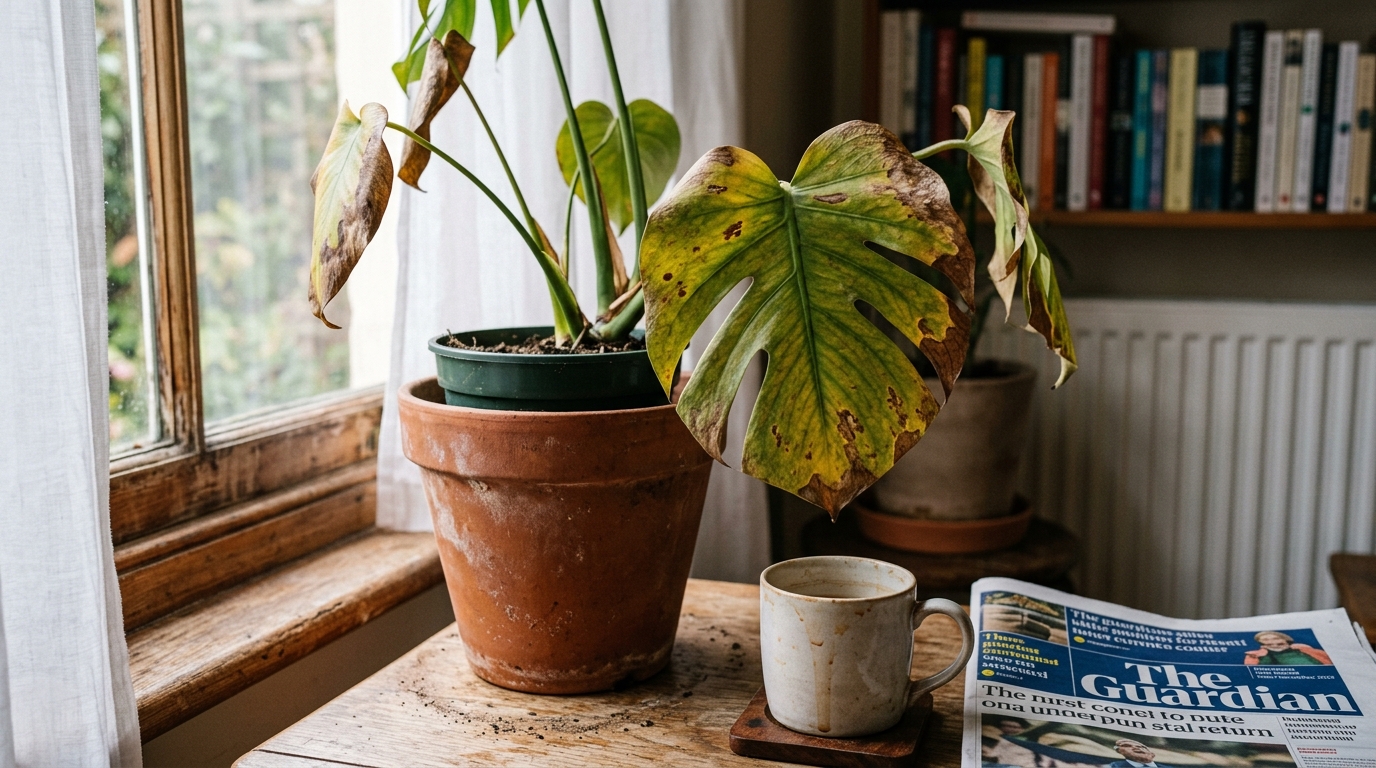
When your Monstera starts throwing out yellow leaves, it’s a proper panic moment. Most plant parents have been there. It’s easy to spend a week convinced an £80 plant is dead, only to realise the culprit is hard tap water. You don’t need to guess what’s wrong—the pattern of the yellowing tells you exactly what the plant is complaining about. In a typical British home, the usual ‘just water it more’ advice is often the worst thing you can do.
The “Is It This or That?” Diagnostic Checklist
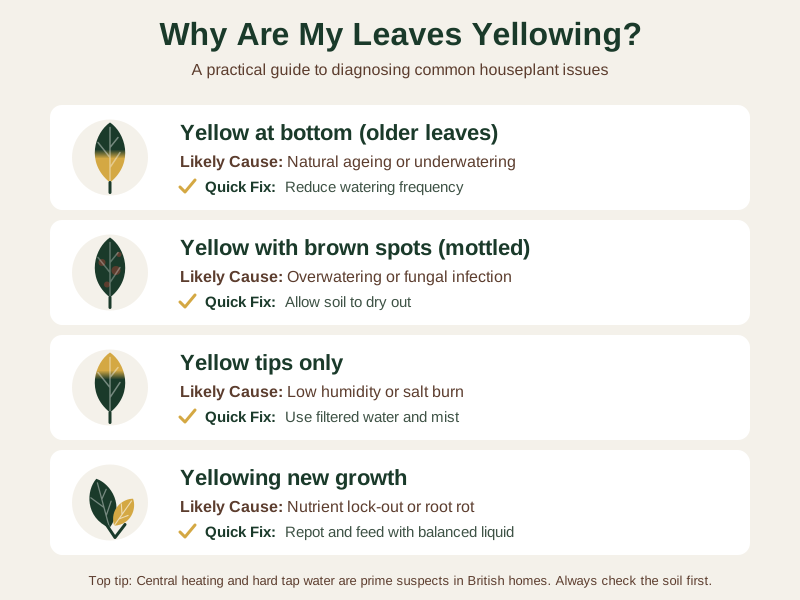
A quick visual scan can tell you exactly what’s wrong. Compare your plant against these four common symptoms—it’s the fastest way to avoid endless guessing.
- Yellow at the bottom (older leaves) – Usually natural ageing or a subtle underwatering issue. The plant is simply shedding its older foliage.
- Yellow with brown spots (mottled) – Classic sign of over-watering or a fungal infection taking hold in soggy soil.
- Yellow tips only – Low humidity or a build-up of mineral salts from hard tap water – the dreaded “salt burn”.
- Yellowing new growth – Nutrient lock-out or root rot; the roots can’t feed the fresh shoots.
If you’re still not sure, the pattern of yellowing usually points to one of these four buckets. Download the Free Houseplant Troubleshooting Checklist now and you’ll have a printable version to compare side-by-side with your Monstera’s symptoms.
Worth knowing: Hard water is the silent killer most of us overlook. In many UK towns, tap water is incredibly hard and increases the alkalinity of potting compost.
The UK Water Hardness Factor (The Hidden Cause)
Hard water is the silent killer most of us overlook. In many UK towns—think Manchester, Birmingham, and massive chunks of London—tap water is incredibly hard. The Royal Horticultural Society (RHS) warns that using hard tap water long-term increases the alkalinity of the potting compost. Those minerals settle on the soil surface as a white crust and, over time, leach into the roots, causing chlorosis (yellowing).
📺 Watch: What is HARD WATER — Water eStore
What it looks like: a faint, powdery ring around the pot’s rim, and the leaves turn a washed-out yellow, especially at the tips.
Solutions you can actually do:
- Filtered water – a basic carbon filter or a Brita jug works fine and costs roughly £15-25.
- Rainwater – collect it in a clean bucket; it’s naturally soft.
- Let tap water sit – leave it uncovered for 24 hours; the heavier minerals settle at the bottom, and you can pour off the clearer top half.
Straight tap water is the usual culprit here. Switch to filtered water and the yellowing typically stops within two weeks, with new leaves coming through a healthy deep green.
Central Heating & Low Humidity: The Winter Stress Test
Radiators are great for keeping your living room warm, but they also turn the air into a desert. In a typical British flat, the relative humidity can plummet once the heating’s on, and Monstera leaves love a moist environment.
What you’ll notice: leaf edges turn yellow and crispy, sometimes with a brown fringe—the plant is literally drying out.
Practical fixes for a British winter:
- Humidity tray – place a shallow tray of pebbles and water beneath the pot; as the water evaporates, humidity rises. A decent tray costs around £10-15.
- Group your plants – a cluster of foliage creates its own micro-climate, boosting humidity without any extra gear.
- Move away from direct heat – even a metre of distance from the radiator can make a difference. Placing a Monstera right on the radiator shelf turns the leaves yellow within a week. Move it to a windowsill a few steps back and it perks up.
Worth knowing: The easiest way to check if your Monstera needs water is to stick your index finger about 2cm into the soil. If it feels wet and heavy, the roots are suffocating.
How Do You Tell if Your Monstera is Overwatered or Underwatered?
You can tell if a Monstera is overwatered by checking for soggy, heavy soil and looking for leaves that turn yellow with mottled brown spots. If it is underwatered, the soil will be completely dry to the touch and the yellowing leaves will feel crispy at the edges. Overwatering is by far the most common issue in British homes, especially in winter when the plant’s growth slows down but we keep watering it out of habit. The easiest way to check is to stick your index finger about 2cm into the soil. If it feels wet and heavy, the roots are suffocating. If it feels barely damp, hold off. Only water when the top few centimetres are dry.
Most of us have mucked it up by treating “wet soil” as “good soil”. Overwatering blocks oxygen to the roots. Dark, water-logged soil paired with yellowing leaves calls for repotting straight away in a well-draining mix — the plant typically recovers within a month.
How to Rescue an Overwatered Monstera
If you have caught the overwatering early, you can save the plant before root rot completely takes over. It is a bit of a faff, but it works.
1. Pull the plant out of its pot Gently slide the Monstera out of its plastic nursery pot. Do not pull it by the stems; tip it sideways and ease the root ball out.
2. Inspect and trim the roots Look closely at the root system. Healthy roots are firm and pale. If you see dark, mushy roots that smell faintly like a stagnant pond, snip them off with sterilized scissors until only the healthy tissue remains.
3. Wrap the root ball in newspaper If the soil is just sodden but the roots are mostly okay, wrap the entire root ball in old newspaper or kitchen roll for a few hours. The paper will draw the excess moisture out of the soil like a sponge.
4. Repot in a chunky mix Put the plant back into a pot with fresh, dry soil. Add a handful of perlite or orchid bark to your standard compost to make sure water drains straight through next time.
Nutrient Deficiencies: When Food is the Cure
Feed with Indoor Plant Food Organic All Purpose Fertilizer (paid link) once a month during spring and summer. It’s gentler than chemical feeds and less likely to burn sensitive roots.
Check Indoor Plant Food Organic All Purpose Fertilizer price → (paid link)
Yellowing new growth often points to a lack of nitrogen or iron. In the UK, many growers rely on generic fertilisers that don’t supply enough micronutrients for aroids.
What to look for: pale, yellow shoots while older leaves stay relatively dark. The fix is a balanced liquid feed. We recommend Growth Technology Houseplant Focus (paid link). It’s a gentle, well-balanced formula that owners report turning limp, yellow leaves into glossy, vibrant ones within two feedings. The product sits in the region of a 1 litre bottle of Growth Technology Houseplant Focus (paid link), which is not cheap but not a con either—it’s worth the investment for a struggling Monstera.
Buy Growth Technology Houseplant Focus on Amazon → (paid link)
If you’re on a tighter budget, a half-strength solution of a general houseplant feed (around £10) can work, but you’ll need to watch for over-feeding signs like leaf scorch. If you want to read more of our trials and errors with different plant feeds, have a browse through the blog.
Pest Control: Fungus Gnats & Mealybugs
A sudden surge of tiny flies or cotton-like mealybugs can stress a Monstera enough to turn its leaves yellow. Fungus gnats thrive in over-watered potting compost, while mealybugs suck sap and divert nutrients.
What works: a regular spray of SB Plant Invigorator (paid link). It’s an eco-friendly foliar spray that doubles as a mild feed, keeping soft-bodied pests at bay. Users love it, but be aware it can get a bit sticky and may need weekly re-applications—a small price for keeping the plant pest-free.
Check SB Plant Invigorator price → (paid link)
For a cheaper, quick knock-down on a light infestation, Doff Universal Bug Control (paid link) can be used, but watch out for potential leaf burn if you over-apply.
See Doff Universal Bug Control on Amazon → (paid link)
Monstera Yellowing Symptoms Checklist
| Symptom | Likely Cause | Quick Fix |
|---|---|---|
| Yellow at bottom (older leaves) | Natural ageing or underwatering | Reduce watering frequency |
| Yellow with brown spots (mottled) | Overwatering or fungal infection | Allow soil to dry out |
| Yellow tips only | Low humidity or salt burn | Use filtered water and mist |
| Yellowing new growth | Nutrient lock-out or root rot | Repot and feed with balanced liquid |
What to Do Now
You now have a clear picture of the four main culprits behind yellow Monstera leaves and a handful of British-specific fixes that actually work. Swap out hard tap water, boost humidity, master the finger test, feed with a balanced liquid, and keep pests at bay—and you’ll see those leaves greening up in no time.
If you’re still unsure which of these factors is the main offender, download our free Houseplant Troubleshooting Checklist. It’s a printable guide that walks you through each symptom and the exact step to take, so you can stop guessing and start fixing.
Got more questions or need a hand with repotting? Drop us a line on the contact page.
Remember, a yellow leaf is just a cry for help, not a death sentence. With the right tweaks, your Monstera will be back to its glossy, fenestrated glory before you know it.
Related Guides
For a complete overview, see our Popular Houseplant Care: Troubleshooting the UK’s Favorite Plants.
Further Reading
Products linked above are ones we recommend based on owner feedback and UK-condition testing.
Note: For specific advice, always consult a qualified professional — content here is for general guidance only.