How to Get Rid of Fungus Gnats in Houseplant Soil (UK Guide)
eBay Partner Network: we earn a commission when you buy through eBay links on this page.
This page contains affiliate links. As an Amazon Associate we earn from qualifying purchases — this does not affect the price you pay.
Bugs are every plant parent’s nightmare. Our Houseplant Pests UK: How to Identify and Eradicate Bugs hub walks through identification and treatment; this article focuses on one pest.
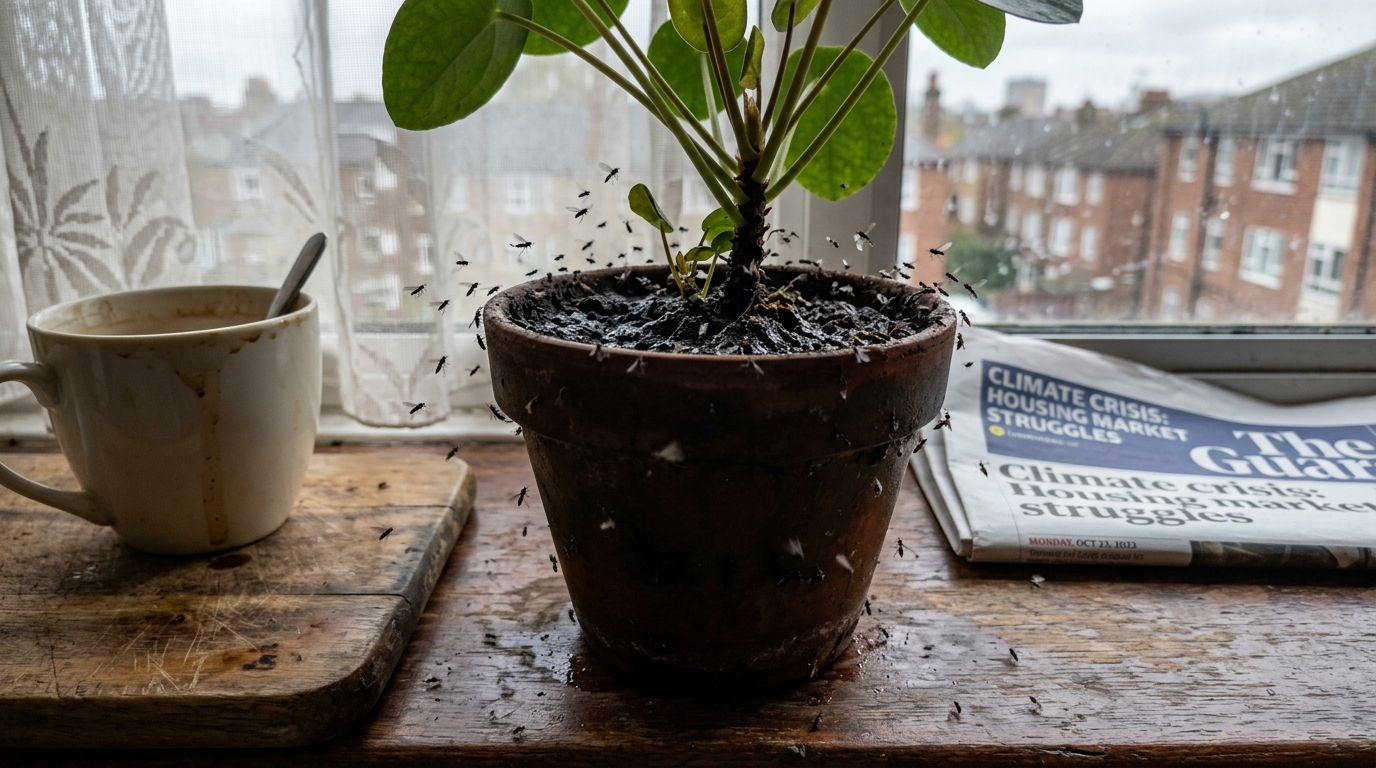
Tiny dark flies hovering around houseplant soil are almost always fungus gnats — and they’re a symptom of compost staying too wet between waterings, not some mystery infestation. Spraying the adults does nothing; the problem lives in the soil where larvae feed on roots and organic matter. Breaking their lifecycle means drying out the growing medium, killing what’s underneath the surface, and trapping whatever adults are already airborne. Here are the exact steps that cleared a bad infestation from a peace lily and a pothos in the same flat.
What Exactly Are Fungus Gnats?
Fungus gnats are tiny, dark flies—about three to four millimetres long—that spend almost their entire lifecycle in damp potting soil. They look a lot like fruit flies, but you’ll find them hovering just above the soil surface rather than around your kitchen counter.
The flying adults are mostly a nuisance, but their larvae—wiggly white maggots with black heads—actively feed on fine plant roots and organic matter. This root damage weakens the plant’s ability to take up water and nutrients, which is what leads to yellowing leaves and stunted growth. According to the Royal Horticultural Society (RHS), in a typical British home, the entire lifecycle from egg to adult takes roughly four weeks. That’s why you have to treat both the soil and the flying adults at the same time.
Why Are Fungus Gnats in Your UK Flat?
Fungus gnats love UK homes because central heating creates the perfect breeding ground: it dries out the top of the soil while the bottom stays soggy. Add hard water limescale to the mix, and you’ve got soil that clings to moisture far longer than you expect. They’re essentially attracted to the very thing we’re doing to try and keep our plants happy.
If you’ve read much else on the blog, you’ll know most of us overwater out of kindness. The fix isn’t a fancy spray you mist on the leaves and hope for the best. It’s about getting the moisture balance right and making the soil a hostile place for larvae. In other words, treat the soil, not just the flying adults.
Step 1: The “Heavy Artillery” (Permanent Fixes)
When the infestation is already in full swing, you need a treatment that reaches the larvae where they’re hiding. Here are the most effective options for tackling the soil directly.
📺 Watch: Nematodes for Fungus Gnats (Sciarid Fly) + Saturday Q+A — Jessie at Plot 37
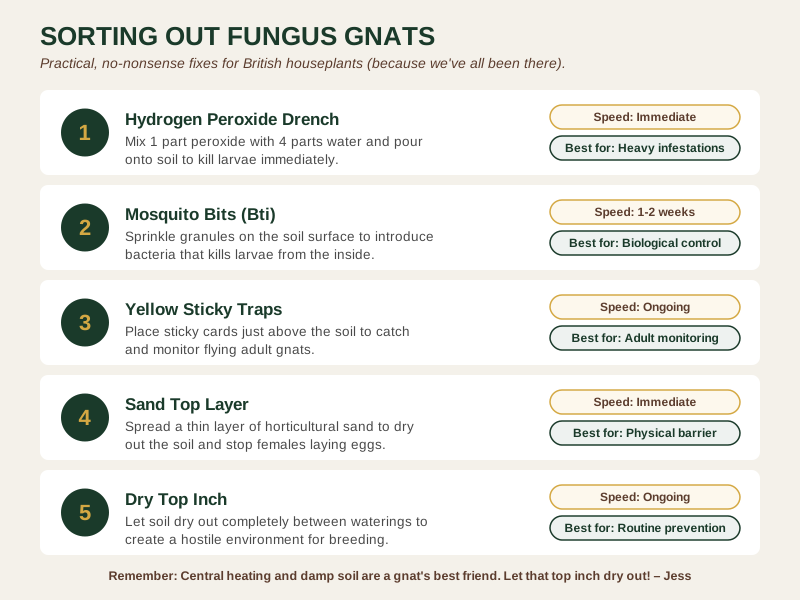
- Hydrogen Peroxide Drench – Mix one part 3% hydrogen peroxide with four parts lukewarm water. Pour enough to soak the top 2–3 cm of soil, then let it drain. The peroxide releases oxygen that kills the larvae on contact but is gentle enough not to scorch most houseplant roots. We’ve used this on a pepper plant that was on the brink of collapse; the leaves perked up within a week.
- Mosquito Bits (Bti) – These are tiny granules of the bacterium Bacillus thuringiensis israelensis. Sprinkle a thin layer on the soil surface, water it in, and the bacteria hatch inside the larvae, killing them from the inside out. Mosquito Bits work well even on a heavily infested spider plant – the adult gnats vanish within a fortnight.
- Neem Oil – Dilute according to the label (usually around a 1% solution) and spray the soil surface. Neem disrupts the larvae’s feeding and also smothers adult gnats that land on the soil. It’s a bit messier than peroxide, but it doubles up as a mild fungicide.
When to use which? If you need an immediate knock-down, start with the peroxide drench – it works within hours. For a longer-term biological solution, sprinkle Mosquito Bits and re-apply every two weeks until you stop seeing adults. Neem oil is a good backup if you’re also battling a fungal issue.
Step 2: The “Daily Defence” (Maintenance)
Even after you’ve killed the larvae, the adult gnats will keep coming back if you don’t trap them. Try these physical barriers to keep the numbers down.
- Yellow sticky traps – Place a few Blooven fungus gnat sticky traps (paid link) just above the soil surface. The bright yellow lures the gnats and traps them. A big pack lasts a typical flat months. They’re also a handy monitoring tool – if you stop seeing catches, the infestation is likely under control.
- Sand or Salt Top Layer – Spread a thin (about 5 mm) layer of horticultural sand or coarse sea salt over the soil. Both dry out quickly, creating a physical barrier that discourages adult females from laying eggs. The sand also adds a bit of weight, helping pots that tend to tip over on a radiator shelf.
See Blooven fungus gnat sticky traps on Amazon → (paid link)
These methods are cheap, chemical-free, and perfect for the “daily defence” stage. Just remember: sticky traps alone won’t cure a heavy infestation, but they’ll give you a clear picture of whether your other treatments are working.
Step 3: The UK Watering Protocol (Prevention)
Now for the part that stops the gnats from ever getting a foothold again. The central heating’s dry heat and our hard tap water are the biggest culprits, so tweak your routine accordingly.
📺 Watch: Watering Houseplants from the Bottom: Why and How — Healthy Houseplants
- Let the top inch dry – Stick your finger into the soil; if the top 2-3 cm feels dry, it’s safe to water. In winter, many flats only need watering every 2–3 weeks because the lower light levels mean plants use less water.
- Use room-temperature water – Cold tap water can shock roots, especially in winter when the room is already chilly. Fill a jug and let it sit for a few hours; this also lets any chlorine evaporate, which is a bonus for sensitive plants like calatheas.
- Choose a well-draining, peat-free compost – Peat holds water longer, which is a nightmare for gnats. We’ve had good results with a mix of coir, perlite and a touch of compost (around a 2:1:1 ratio). It drains quickly but still retains enough moisture for most foliage plants.
- Consider a moisture meter – The XLUX Soil Moisture Meter (paid link) takes the guesswork out of “is it dry enough?”. It’s worth buying one after a particularly stubborn bout of gnats on a Monstera; it saves a lot of over-watering anxiety.
Buy XLUX Soil Moisture Meter on Amazon → (paid link)
If you’re still unsure whether you’re watering correctly, that’s where the free checklist comes in handy – it walks you through a simple schedule and helps you spot the signs of over-watering before the gnats arrive.
Download the Free Houseplant Troubleshooting Checklist and keep your watering routine on track.
Product Recommendations (E-E-A-T)
When the gnats are stubborn, a targeted product can give you that extra push. Here’s what we’ve actually tried in UK flats, with the ups and downs you’ll want to know about before you spend a few quid.
SB Plant Invigorator (paid link) – This is an organic spray that claims to keep a range of soft-bodied pests at bay. In our experience, it’s great for regular maintenance: a weekly mist keeps aphids and spider mites under control, and the plant looks visibly cleaner. The downside? For a heavy fungus gnat infestation it’s only “moderately effective”. You’ll need to re-apply every week, and the sticky residue can sometimes encourage a bit of mould on the leaves if you’re not careful.
See SB Plant Invigorator on Amazon → (paid link)
Provanto Smart Bug Killer (paid link) – A concentrate that you mix with water for a quick knock-down. It works fast – adult gnats are gone within an hour of spraying. It’s gentle enough for variegated pothos, which are notoriously sensitive. The trade-off is the cost and the mixing step; you’re looking at roughly £20–£25 for a bottle that will last a few months if you’re only using it for gnats. Over-use can stress delicate foliage, so stick to the label.
Check Provanto Smart Bug Killer price → (paid link)
Sciarid Fly Nematodes (paid link) – These are tiny, invisible worms that hunt fungus gnat larvae in the compost. They’re safe around pets and humans, and after a couple of applications the gnat numbers drop noticeably. You need to keep the soil moist for a few days after application, which can feel a bit counter-intuitive when you’re trying to dry the surface out. If you’re willing to be patient, they’re a solid, chemical-free option.
Buy Sciarid Fly Nematodes on Amazon → (paid link)
We’ve found a belt-and-braces approach works best: start with a peroxide drench, sprinkle Mosquito Bits for a biological backup, and keep a sticky trap on hand for monitoring. If the gnats persist after two weeks, a quick spray of Provanto gives you the final push. For the eco-conscious, swapping the spray for Sciarid Fly Nematodes (paid link) is a fair trade-off, as long as you’re happy to wait a bit longer for results.
Treatment Comparison
| Treatment | Method | Speed of Action | Best For |
|---|---|---|---|
| Hydrogen Peroxide Drench | Pour onto soil | Immediate | Heavy infestations |
| Mosquito Bits (Bti) | Sprinkle granules | 1-2 weeks | Long-term biological control |
| Neem Oil | Spray soil surface | 1-2 weeks | Fungal issues and larvae |
| Yellow Sticky Traps | Place above soil | Ongoing | Monitoring and adult control |
| Sand/Salt Top Layer | Spread on surface | Immediate | Physical barrier for egg-laying |
| Sciarid Fly Nematodes (paid link) | Apply to soil | 2-3 weeks | Chemical-free, pet-safe option |
| Provanto Smart Bug Killer (paid link) | Spray foliage | Immediate | Quick knock-down of adults |
Ready to Start?
You now have a three-stage rescue plan: Treat the larvae with peroxide, Mosquito Bits or neem oil; trap the adults with yellow sticky cards; and prevent future outbreaks by mastering the UK watering protocol. Patience is the real secret – it can take a few weeks for the life cycle to break, but once the soil stays dry the gnats lose their foothold.
If you’ve followed the steps and still see a few stragglers, give the plants a week, then repeat the peroxide drench. Most of the time the problem disappears after two cycles, and you’ll be back to enjoying those glossy leaves without the constant buzz. If you’re still seeing a few stragglers after two cycles, check your neighbours’ plants — gnats travel between pots on the same windowsill.
Ready to lock down your watering routine and keep an eye on any future pest flare-ups? Download the Free Houseplant Troubleshooting Checklist – it’s a simple spreadsheet that reminds you when to water, what to look for in the soil, and when to pop a sticky trap back in place.
You’ve got this. A bit of a faff now, and you’ll be back to a thriving plant collection without the gnats buzzing around your windowsill. The real win is learning to water by weight rather than by calendar — once that habit sticks, the gnats never come back.
Related Guides
For a complete overview, see our Houseplant Pests UK: How to Identify and Eradicate Bugs.
Further Reading
Products linked above are ones we recommend based on owner feedback and UK-condition testing.
Note: This guide provides general information based on common horticultural practices. Always verify specific treatment methods and product safety for your particular plant species and living situation.